Salmon and tuna that you commonly eat may be silently carrying an invisible health risk.
A research team led by Chair Professor Chunmiao Zheng from the School of Environment and Sustainable Engineering, Faculty of Engineering, Eastern Institute of Technology, in collaboration with Associate Professor Wenhui Qiu’s group at Southern University of Science and Technology and multiple partner institutions, has found that per‑ and polyfluoroalkyl substances (PFAS) continuously bioaccumulate along marine food chains and enter the human body through marine fish on dining tables.
For the first time, the team systematically clarified the exposure risks posed by forever chemicals in 212 species of edible marine fish worldwide, providing critical scientific support for safeguarding food safety.
The relevant research findings were published in Science on December 19 (Beijing time).
Hidden Hazards of Forever Chemicals in Daily Life
PFAS are a class of artificially‑synthesized chemicals known as forever chemicals for their wide application in industrial production and consumer goods. They can be found in cosmetics, non‑stick pan coatings, household cleaners, sticky notes, carpets, dental floss, snowboards, outdoor sportswear, sports shoes and many other everyday products.
Highly persistent in the environment, these substances can bioaccumulate through food chains and build up inside the human body over time, posing potential threats to human health. Studies indicate that PFAS may impair fertility, induce liver toxicity, damage kidney function, cause neurotoxicity and trigger carcinogenic effects.
According to Professor Chunmiao Zheng, this study on human exposure risks to per‑ and polyfluoroalkyl substances from marine fish consumption systematically evaluated PFAS bioaccumulation concentrations and dietary exposure risks for populations consuming 212 edible marine fish species globally. It clearly depicts the full journey of PFAS: from industrial emissions, uptake by marine fish, transfer via global trade networks and eventual entry into the human body. The work reveals how environmental health risks are invisibly transmitted and redistributed within globalized supply chains, bearing great scientific and practical significance.
Invisible Travel of Pollution Uncovered via the Global Risk Map
How are PFAS concentrations in marine fish linked to their ocean habitats? The research team carried out a global survey of PFAS levels in edible marine fish.
They integrated 20‑year seawater PFAS monitoring datasets covering 3,126 sites across the globe, and applied marine food‑web models to predict PFAS concentrations in 212 edible marine fish species accounting for 99 % of catches in the studied regions.
PFAS concentrations in marine fish correlate with historical regional emissions and seawater dilution capacity. Moreover, fish occupying higher trophic levels show markedly higher tissue PFAS levels. The team also conducted PFAS concentration measurements on 150 real‑world fish samples covering 87 species from 33 families worldwide using high‑performance liquid chromatography‑mass spectrometry, to validate model predictions spanning 2010‑2021.
Sample‑level validation shows that 33 % of data points fall within a factor‑of‑two error range and 94 % within a factor‑of‑ten error range. Validation at trophic‑level scales also largely stays within the factor‑of‑ten error margin, with scattered outliers covered by the variation range of field measurements.
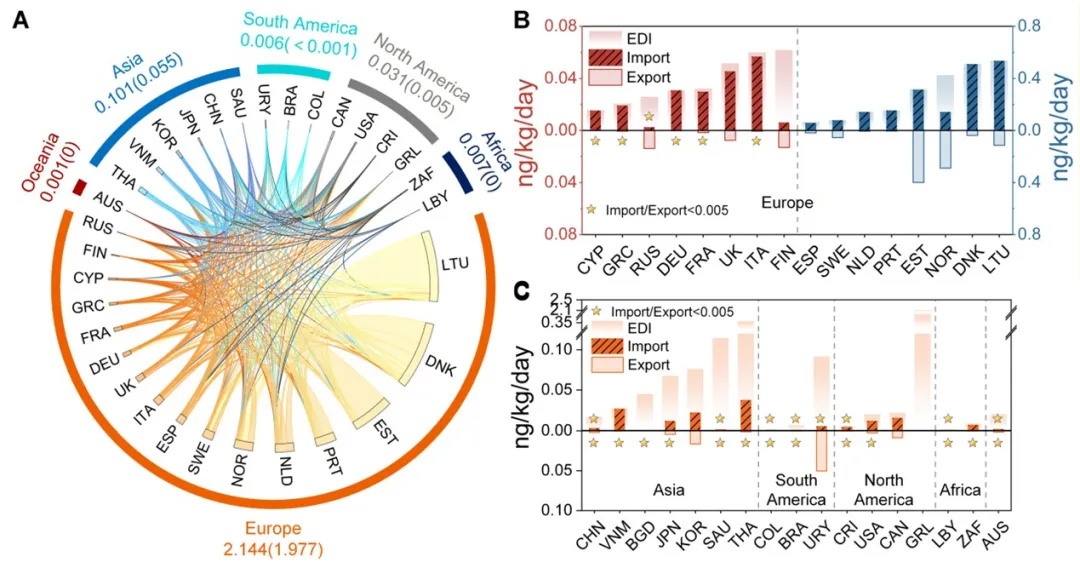
Combining global fisheries catch, trade and demographic datasets, the study estimated population‑specific daily intake of C8‑PFAS from marine fish consumption. Results show that PFAS are transported via global seafood trade from regions with high contaminant residues to low‑residue regions. This finding quantifies global health risks arising from PFAS intake through seafood, especially for countries and regions relying heavily on imported seafood, and demonstrates how global food trade reshapes PFAS exposure patterns.
In other words, PFAS can “hitch a ride” on international shipping, moving from heavily‑polluted marine areas onto dinner plates in countries with clean coastal waters. Even residents of nations with pristine coastlines may face extra risks from imported seafood.
Longer‑Chain PFAS: Substances of Greater Concern
Every bite of marine fish people consume may carry pollution signatures of its ocean habitat. Through global trade networks, these signatures quietly connect human health across the world to distant marine environments.
As pointed out by Associate Professor Wenhui Qiu, longer‑chain PFAS deserve greater vigilance. Compounds such as perfluorodecanoic acid (PFDA, C10), perfluorononanoic acid (PFNA, C9) and perfluoroundecanoic acid (PFUnDA, C11) possess stronger bioaccumulation potential, elevating PFAS levels in fish and subsequent human dietary exposure.
Their bioaccumulative properties also affect reference doses derived from toxicological tests, leading to lowered intake reference standards and under‑recognized potential human‑health hazards. The health risks of longer‑chain PFAS merit further attention.
This research establishes an innovative analytical framework to systematically reveal bioaccumulation dynamics of PFAS in marine food webs and resulting population exposure risks. Integrating environmental concentration records, marine food‑web models, bioaccumulation factors, global fisheries statistics, trade networks and health‑risk assessment, the framework traces the complete transmission pathway of PFAS from aquatic environments into fish and onward to humans via dietary intake.
The study identifies pronounced biomagnification of PFAS within marine food webs, which underpins bioaccumulation in fish and subsequent human dietary exposure.
“Notably, longer‑chain PFAS present more prominent ecological and health risks worldwide due to their enhanced persistence and bioaccumulation potential,” stated Chunmiao Zheng. This work clarifies inter‑homologue differences in PFAS bioaccumulation and resulting risk disparities, furnishing key scientific evidence for fishery‑resource management and PFAS regulatory policymaking.
Wenhui Qiu, Associate Professor at the School of Environmental Science and Engineering, Southern University of Science and Technology, and PhD candidate Ge Yang are co‑first authors of the paper. Chair Professor Chunmiao Zheng from Eastern Institute of Technology is the principal investigator and co‑corresponding author.
Additional co‑corresponding authors include Associate Professor Wenhui Qiu (Southern University of Science and Technology), Professor Zhaomin Dong (Southeast University) and Professor Minghong Wu (Fuzhou University). Southern University of Science and Technology serves as the first‑author institution.
This research was supported by the National Natural Science Foundation of China, and research grants from Guangdong‑Shenzhen, Zhejiang‑Ningbo and other provincial‑municipal funding programs.
Paper information: https://www.science.org/doi/10.1126/science.adr0351
About the Research Group
The group’s research covers groundwater‑contamination mechanisms and remediation technologies, watershed eco‑hydro‑environmental processes, and impacts of global change and emerging pollutants on sustainable water‑resource utilization. The group lead, Chunmiao Zheng, is Vice‑President and Chair Professor at Eastern Institute of Technology.
Contact: czheng@eitech.edu.cn