Have you heard of microplastics? These tiny plastic fragments, less than 5 millimeters in diameter and invisible to the naked eye, are found in water, food and even air. In a joint multi‑institutional study, researchers conducted the first systematic analysis of microplastics in human intestinal tumor tissues. They found that the detection of microplastics is statistically correlated with elevated tumor recurrence risk and aggravated gastrointestinal symptoms.
This work explores the intrinsic links between microplastic exposure and intestinal pathological changes. It supplies key epidemiological evidence for understanding the potential health impacts of microplastics, and provides solid theoretical and practical support for environmental‑health risk assessment of microplastics and further advances in environmental‑medical research.
Conducted by the team of Chair Professor Chunmiao Zheng at Eastern Institute of Technology and Associate Professor Wenhui Qiu at Southern University of Science and Technology, together with Shanghai Jiao Tong University, Shenzhen Second People’s Hospital and other institutions, the study was recently published in Nature Health.
Microplastics Detected in More Than Half of 188 Intestinal Tumor Samples
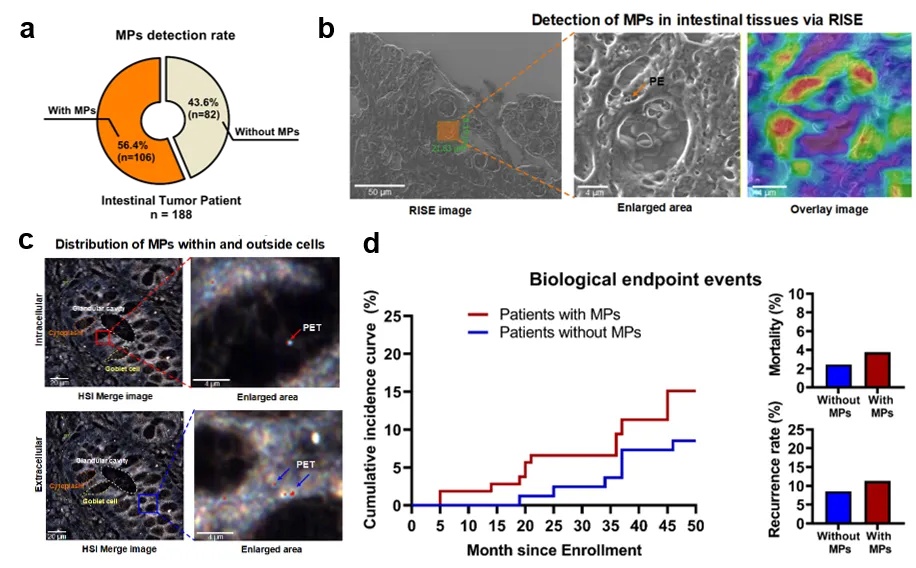
The research team collected 188 surgically‑resected human intestinal tumor samples. Using advanced tools including confocal microscopy, Raman spectroscopy and electron microscopy, they screened and localized microplastics within the tissues. Microplastics were detected in 56.4 % of samples. Polyethylene terephthalate (PET), widely used in beverage bottles and food packaging, was the most frequently identified type. These microplastics were observed either adhering around cells or even inside cells.
Patients were then divided into microplastic‑positive and microplastic‑negative groups for comparison using clinical follow‑up data spanning up to 34 months, including tumor recurrence, severity of gastrointestinal discomfort and inflammatory markers.
Microplastic‑Positive Patients Show Higher Recurrence Risk and Worse Gastrointestinal Disturbances
Statistical analyses reveal that patients in the microplastic‑positive group exhibited higher cumulative incidence of tumor recurrence as well as worse gastrointestinal symptom scores, such as more severe abdominal pain, diarrhea and nausea.
It should be emphasized that only statistical correlation rather than causal relationship has been identified in this study. The results cannot prove that microplastics directly trigger tumor recurrence or symptom deterioration, as other confounding complex factors may be involved. Researchers note that larger‑scale, long‑term prospective cohort studies together with animal and cell experiments are required for further validation.
Microplastic pollution represents a global environmental concern. Humans are mainly exposed through dietary intake (bottled water, seafood, salt, etc.) and inhalation. As one of the organs with frequent external contact, the intestine is highly susceptible to microplastic deposition. Prior studies have detected microplastics in human blood, placenta, lung and other tissues; nevertheless, systematic investigations on microplastic features within diseased intestinal tissues and their links with clinical indicators remained scarce.
Combining high‑precision microplastic detection with long‑term clinical follow‑up data for the first time, this study offers new clinical evidence for understanding how environmental contaminants may potentially affect human health.
The team states that follow‑up controlled‑exposure tests, animal models, cellular assays and large‑scale prospective population‑based follow‑ups will be carried out to reveal whether and how long‑term microplastic exposure influences intestinal immunity, inflammatory responses and the tumor microenvironment. These efforts aim to generate scientific foundations for targeted health‑risk evaluation and prevention‑control strategies.
Honghong Chen, a joint‑training PhD candidate of Eastern Institute of Technology and Shanghai Jiao Tong University, and physician Zhaohui Liu from Shenzhen Second People’s Hospital are co‑first authors. Wenhui Qiu serves as the corresponding author. Chunmiao Zheng is Honghong Chen’s PhD supervisor and a co‑author of the paper. This research received financial support from the National Natural Science Foundation of China and key provincial‑municipal research programs in Guangdong‑Shenzhen and Zhejiang‑Ningbo.
Paper DOI: https://doi.org/10.1038/s44360-026-00123-z